Announcing our $4.3M-to-date Seed Round to Build Operational Superintelligence
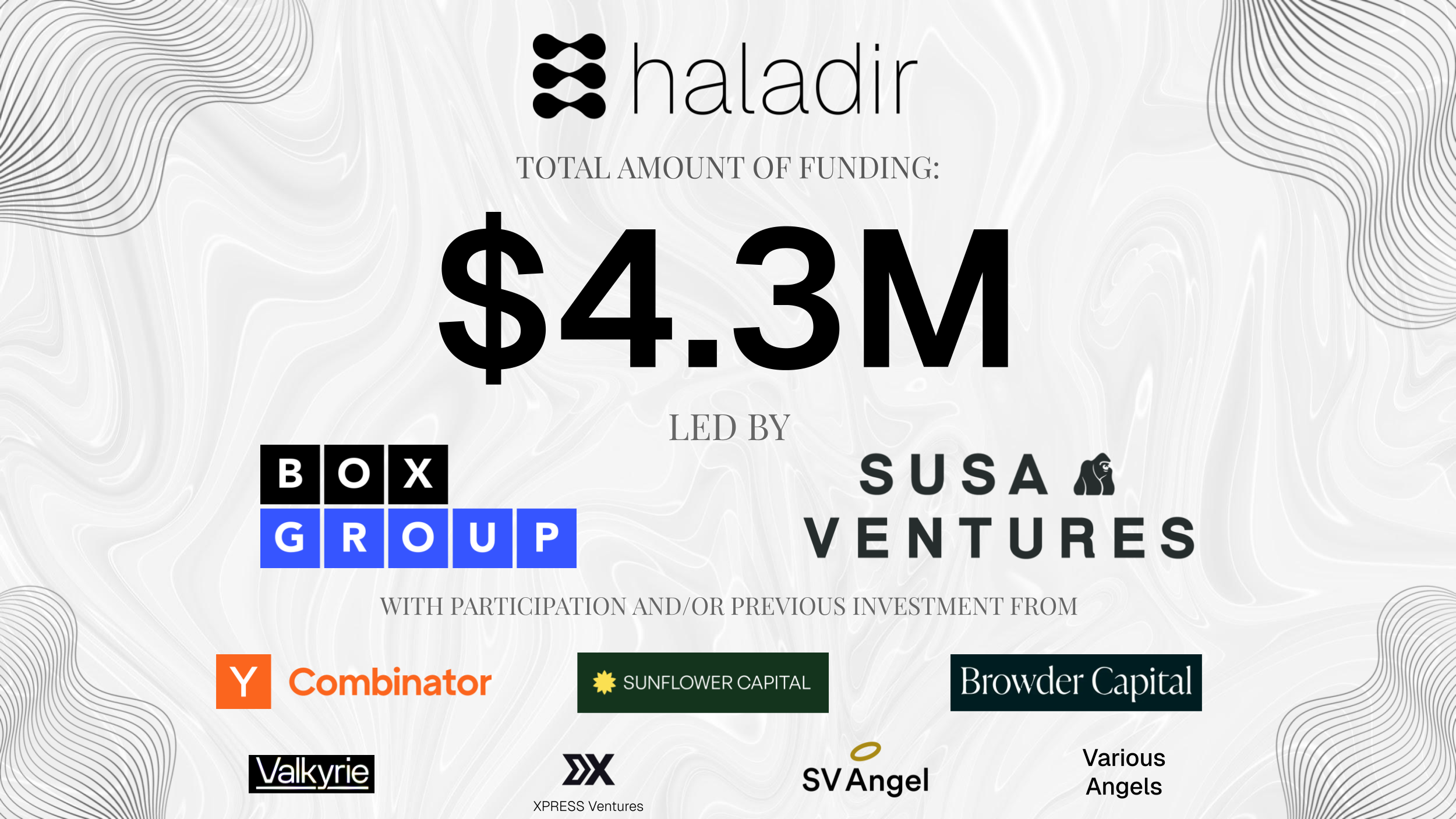
Our Seed Round
We at Haladir just raised our seed round, bringing our total funding to $4.3M. We're using it to build operational superintelligence. The round was led by BoxGroup and Susa Ventures, with participation from Sunflower Capital, Valkyrie Ventures, XPRESS Ventures, and various angel investors, following earlier backing from Y Combinator, SV Angel, and our first believer, Josh Browder.
Building Operational Superintelligence
“Superintelligence” may be a hyped word, but for us, it means something concrete in the context of logistics and supply chains. We believe LLMs are powerful tools, but without the proper scaffolding, they are terrible decision-makers. At a fundamental level, LLMs are not intelligent. Instead, they make great educated guesses at incredible speeds.
Recognizing this, we believe LLMs are useful insofar as they augment more traditional means of modeling. SMT/SAT solvers, MILP solvers, OR tools, forecasting models, and even simple linear programming models have become extraordinarily powerful over the last decade, achieving solver speeds once thought impossible. Instead of offloading deterministic decision processes to LLMs, as many agent-style workflows attempt, we should be using LLMs as formalization tools. The LLM translates an operation’s rules into precise constraints and proposes the tunable parameters inside each constraint; the deterministic solver does the actual work of finding the optimal answer.
After all, LLMs are language models, and nothing more, so why try to shoehorn them into decision-making? Just as LLMs are great at writing code because code is verifiable, LLMs can be great at decision-making when those decisions are bounded by constraint optimization or other traditional ML and forecasting techniques.
From Data to Decisions
Decisions that eliminate millions in losses are only possible when the model representing your operations is both accurate and flexible. Most logistics organizations have neither, not for lack of will, but because the underlying structure isn't there to support either property.
The first step is to take the distributed, often siloed data networks that a 3PL or distributor operates and unify them into a single structured representation. In practice, this means targeting the WMS (warehouse management system), TMS (transportation management system), and OMS (order management system) first, unifying their schemas, cleaning the underlying data, and exposing it as an operational graph that flexible modeling can actually consume. Connectivity is no longer the hard part; making the data interpretable is. Two systems will describe the same SKU, the same shipment, and the same shift in inconsistent ways, and the substrate has to render that mess legible instead of pretending everything is clean.
The second step is formalization: encoding the operation’s rules, dependencies, and constraints precisely enough for both a model and a solver to reason about them. Process mining is one component of this: working backward from clean event data to recover the real control-flow graph the operation actually follows. But it is only one piece. The real process at a 3PL is rarely what is documented in an internal wiki. Operators have learned workarounds, bottlenecks live in places no one named, and the recovered process almost always disagrees with the official one. That formalized, recovered process is what the optimizer should be calibrated against, because it is what is actually running.
Only after these two steps does the question of what to optimize for become tractable. Even then, it is often the hardest part. In some cases, the objective is obvious: demand forecasting minimizes error; vehicle routing minimizes total distance under time-window constraints. For many of the most valuable problems, though, defining the objective is itself the bottleneck. A warehouse manager’s job involves navigating a Pareto frontier across service level, labor cost, equipment wear, peak preparedness, and a dozen contractual obligations. A single-objective formulation produces a "correct" answer that everyone disagrees with. Choosing the right scalarization, or the right multi-objective frontier and the right way to traverse it, is where operations research stops being a textbook exercise and starts being engineering.
Our Next Steps
We are working today with 3PLs, distributors, and frontier AI labs to put operational superintelligence into practice. The most obvious starting point is the existing ML stack inside a 3PL: demand forecasting, pick-path optimization, and ETA prediction. Improving their error and optimality cuts measurable losses in a margin-constrained business. From there, the same modeling discipline can expand across the company, informing not only predictive layers but also the decision processes underneath them.
Every operational decision should be informed by the most accurate representation of how a business actually operates. In logistics today, and across every industry over time, every decision should be automated through a framework that delivers the best available action at every moment. That is what earns the right to be called operational superintelligence, and we are just getting started.